How to build your vision board for a better future
A vision board isn't decoration. It's a decision filter for the life you're actually going to build.
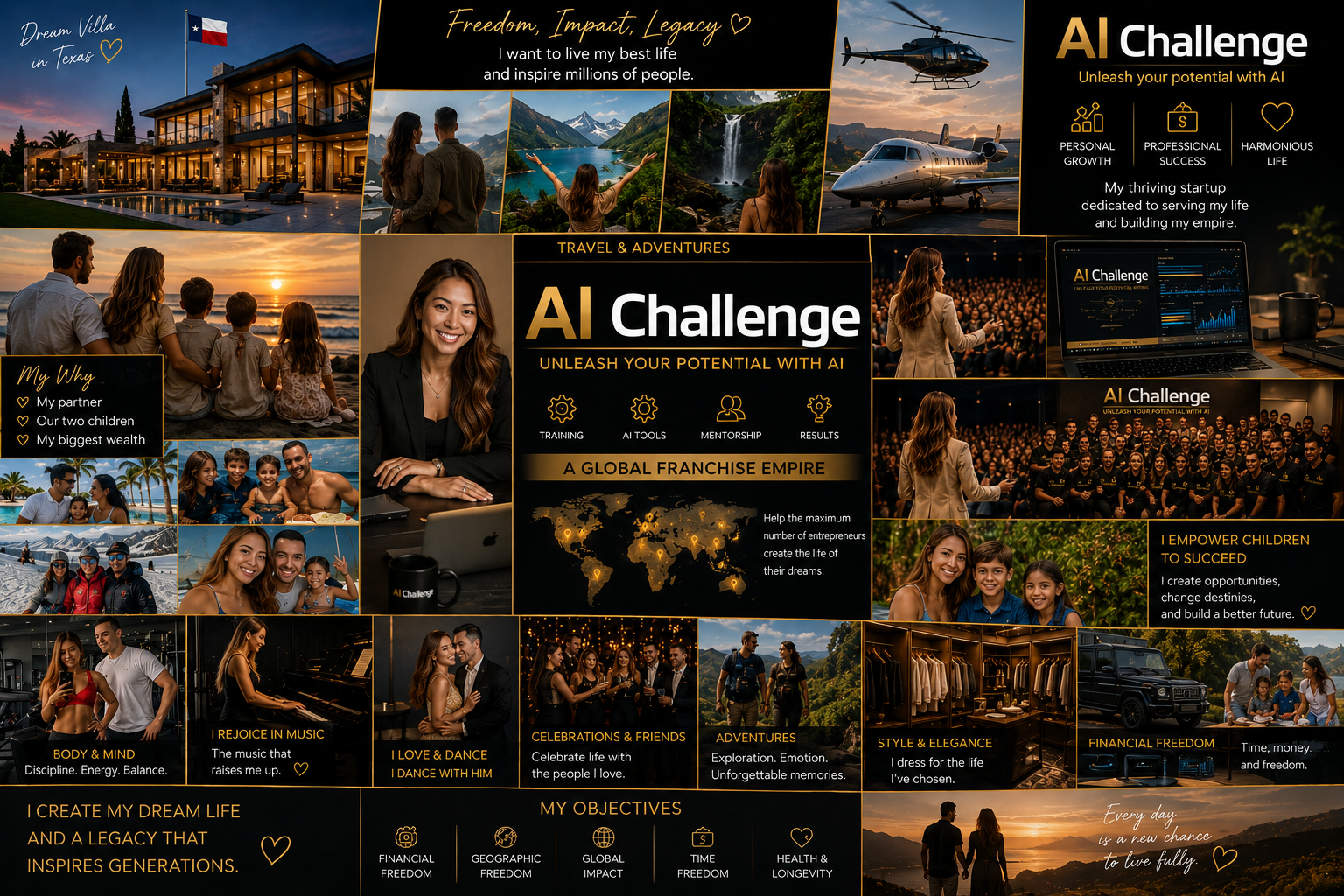
Above — my own AI Challenge vision board
Most people build their life by default. They react to opportunities, emergencies and other people's expectations — and one day they look at their daily routine and wonder how they ended up there. A vision board flips that: it forces you to decide, upfront, what your life is going to look like. It's an act of design.
If you're reading this, you probably want more — more freedom, more impact, more alignment between your business and the life it's supposed to fund. This article shows you how to build a vision board that isn't a cute Pinterest moodboard but an actual decision-making tool.
Why a vision board actually works
Your brain filters millions of inputs every day through the Reticular Activating System (RAS). It lets through what you've labeled as important. When you visually define your future, you reprogram that filter: opportunities, people and ideas that match your vision suddenly become "visible".
Combined with clarity, a vision board gives you three things: direction (you know where you're going), a decision filter (you say no much faster to anything that doesn't serve the vision) and emotional fuel (you reconnect with your why in 5 seconds instead of an hour of coaching).
A life is never beautiful by accident. It's beautiful because it was designed, and then defended every single day.
Step 1 — Define your 7 life pillars
A powerful vision board isn't a shopping list. It covers your entire life. Before you look for images, sit down for 30 minutes and write what you actually want in each of these pillars:
- Mission & business — what impact, what revenue, what model.
- Family & relationship — what kind of connection, how much real time together.
- Health & energy — body, sleep, food, training.
- Financial freedom — amount, income streams, asset level.
- Geographic freedom & experiences — travel, places, adventures.
- Growth & spirituality — what you read, meditate on, learn.
- Legacy & contribution — what you leave behind.
If one pillar is fuzzy, the whole vision wobbles. It's exactly like a business: what isn't measured can't be managed, and what isn't visualized doesn't get built.
Step 2 — Write your statements in the present tense
Words come before images. For each pillar, write 1 to 3 sentences in the present tense, as if it were already true. Not "I'd like to", not "I hope to". "I live in a villa in Austin, Texas. I travel 4 times a year with my family. My business generates X per month thanks to AI systems."
These sentences become the captions on your board. They turn generic images into personal commitments. That's what separates a vision board from a moodboard.
Step 3 — Pick images that hit you in the gut
Simple rule: if an image doesn't trigger anything in you, it's useless. You're looking for visuals that produce an emotional reaction — pride, excitement, almost fear because it feels that big. For my own board, I included:
- The villa in Texas — not a generic villa, the one I actually want.
- My partner and our two children — the reason for everything.
- Aura Companion, my startup — the tool that serves my life and my empire.
- A scene where I'm speaking to a packed room of entrepreneurs.
- The world map of my franchised empire.
- A piano, because I want to play again.
- A walk-in closet, because I dress for the life I've chosen.
Mix tangible (villa, car, closet) and intangible (impact, legacy, freedom). The brain needs both: the concrete to aim at, the abstract to give it meaning.
Step 4 — Compose the board like a piece of art
Form matters. An ugly vision board ends up in a drawer. Here's the structure that works — the one you can see on my own board at the top of this article:
- A strong center: your mission and identity (the "who I am").
- Around it: life pillars in thematic clusters.
- Top or bottom: a signature quote that captures your why.
- A consistent color thread (mine: black + gold, because that's the energy I want to embody).
- Short captions, first person, present tense.
You can build it in Canva, Figma, Photoshop, or with generative AI like I did. The tool doesn't matter. The clarity does.
Step 5 — Use it every single day (or it does nothing)
A vision board sleeping in a folder changes nothing. Here's how to put it to work:
- Set it as the wallpaper on your laptop and phone.
- Print it large above your desk.
- Look at it for 2 minutes every morning before opening email.
- Before any important decision, ask: "does this yes move me closer to the board?"
- Update it every 6 to 12 months — your vision must evolve with you.
Step 6 — Align your business with your vision
Here's what nobody tells you: a vision board without a business system to fund it stays a fantasy. That's exactly why we built the AI Challenge Business. Your vision defines the destination. The business, the AI systems, the agents and the automations are the vehicle.
Freedom isn't a feeling. It's a system. And a system can be built.
If your vision says "travel 4 months a year", your business must run without you. If it says "global impact", you need scalable systems, not selling your time. If it says "7-figure financial freedom", you need premium offers, funnels that convert and AI that executes while you sleep.
That's exactly what we install with our clients. The board says what. The Challenge delivers the how.
Bottom line
Building your vision board is how you stop letting life happen to you and start designing it. It's the simplest — and most radical — act of taking back control. Block two hours this weekend. Build yours. Then build the business that's going to fund it.
Turn your vision into a real business
The Challenge Business IA gives you the systems, AI agents and coaching to build the life on your board — not just dream about it.
Discover the Challenge